
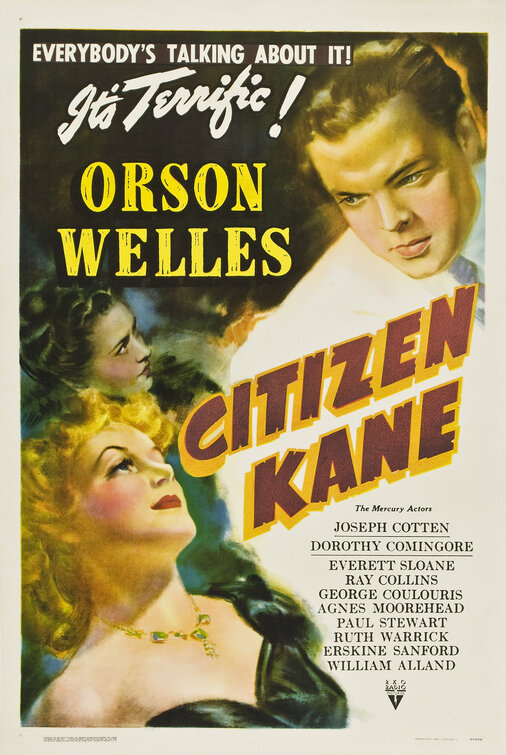
It’s amazing, even after 85 years, that CITIZEN KANE, which premiered in New York May 1, 1941, managed to get shown in movie theatres.
The problem was that Orson Welles’ story of newspaper mogul/politician Charles Foster Kane was modeled, many believed, after newspaper mogul/politician William Randolph Hearst. Concerns over how closely the RKO film, written by Herman J. Mankiewicz & Welles, depicted Hearst and his longtime mistress, silent movie star Marion Davies, resulted in strenuous efforts to keep KANE out of cinemas.
The lengths to which MGM went to kill KANE, are themselves a good thriller. As Welles was shooting in 1940, word spread that Kane was meant to be Hearst and no-talent singer/actress Susan Alexander Kane was the talented and successful actress Davies.
Welles told RKO president George Schaefer that Kane was a composite character and that Alexander definitely wasn’t Davies. Nonetheless, Schaefer sensed serious trouble ahead. Hearst was the day’s most powerful media mogul with newspapers, magazines, a newsreel, a wire service and radio stations — clearly, a formidable enemy.
A possible way out came in a call to Schaefer, prior to KANE’s release, from Nicholas Schenck, chairman of Loew’s, Inc., the NY theatre chain that owned MGM. Schenck asked Schaefer to come see him, which Schaefer did since that was, in effect, a command. MGM president Louis B. Mayer was a longtime friend of Hearst, whose Cosmopolitan Pictures was based for years at MGM. Schenck confided that Mayer would repay RKO the $800,000 it spent to produce KANE if Schaefer would have KANE’s negative and all its prints destroyed.
That put Schaefer in a decidedly difficult spot. He’d crossed swords before with Mayer and wasn’t going to give in to him now. Schaefer felt RKO’s board would say take the money, so he didn’t put this in front of them. He greenlighted KANE’s release, himself, after running it past RKO lawyers who, reportedly, altered only one line in the screenplay. But he couldn’t get the film played anywhere except in RKO’s own small theatre circuit.
NYC’s Radio City Music Hall, which like RKO was backed by Rockefeller money and the Chase Bank, wouldn’t play the critically acclaimed movie because Hearst’s powerful Hollywood columnist, Louella Parsons, said it shouldn’t be shown.
Schaefer finally pressured the big Warner Bros. theatre circuit to book KANE, threatening a lawsuit for conspiracy with MGM if it refused. Once WB agreed to play it, KANE was on the road to its now legendary success.
KANE went on to receive nine Oscar nominations — including, picture, director, actor (Welles) & original screenplay — but won only for screenplay. In 2006 the Writers Guild of America celebrated KANE as #4 on its all-time 101 Greatest Screenplays.


Leave a Reply