
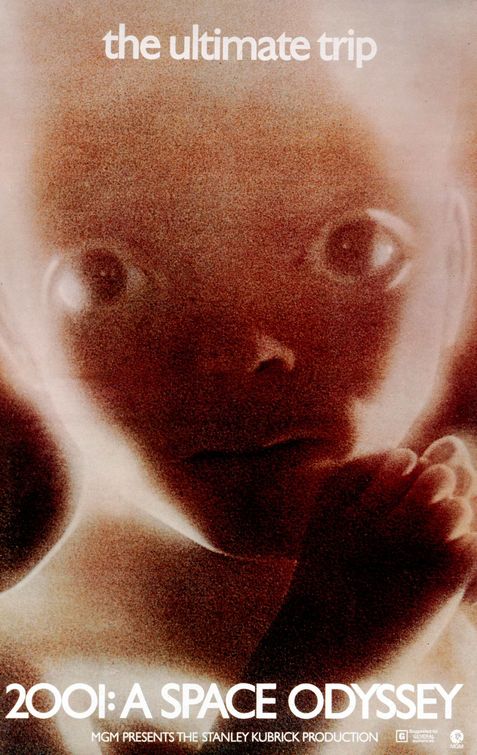
When we say Oscar’s not fond of sci-fi, that includes classics like Stanley Kubrick’s 2001: A SPACE ODYSSEY, which MGM premiered in New York April 3, 1968.
Given its legendary status, it’s hard to believe 2001’s only Oscar win was for Kubrick’s visual effects. It didn’t lose for best picture as it wasn’t even nominated. There were, however, losses for Kubrick for directing & co-writing with Arthur C. Clarke and a loss for art direction-set decoration. The Academy had nominated Kubrick & Clarke for original screenplay although they’d based their script on Clarke’s 1948 short story “The Sentinel.” The Oscar went to Mel Brooks for writing THE PRODUCERS.
No one was shocked in 1969 by Oscar’s snubs because the critics hated 2001. The NY Times called it, “Somewhere between hypnotic and immensely boring.” Variety loathed its “confusing, long-unfolding plot.” And The New Yorker’s Pauline Kael dismissed it as, “the biggest amateur movie of them all.”
The bad reviews were no surprise. At the NY premiere, 241 people walked out — including Rock Hudson, who asked, “Will someone tell me what the hell this is about?” The filmmakers had set out to avoid linear Hollywood storytelling. “If you understand 2001 completely, we failed,” Clarke noted. “We wanted to raise far more questions than we answered.”
Since then, of course, Hollywood’s come to understand and applaud 2001. Steven Spielberg said it was “the big bang” for his generation of filmmakers and George Lucas acknowledged it was a major influence on STAR WARS.
The project originated with Kubrick reaching out to Clarke, saying he wanted to make “the proverbial good science-fiction movie.” Clarke suggested his story “Sentinel,” where an alien object is discovered on the Moon. The 2001 movie & the novel that they co-wrote opens with a Dawn of Man scene relating to another Clarke story, “Encounter at Dawn,” while the film’s Star Child ending echoes Clarke’s novel “Childhood’s End.”
When 2001 opened, it did not do well at the boxoffice. MGM was going to pull it out of theatres, but held off when exhibitors started to notice large numbers of young adults coming to see it. Their enthusiasm for 2001 came from watching the Star Gate ending where the astronaut Dave (Keir Dullea) becomes a fetus within a transparent bubble floating in space. Watching this after they’d taken psychedelic drugs generated great word of mouth that suddenly made 2001 a boxoffice hit with solid ticket sales of $68M worldwide on a budget of $12M.
 ZAMM.COM
Leave a comment