
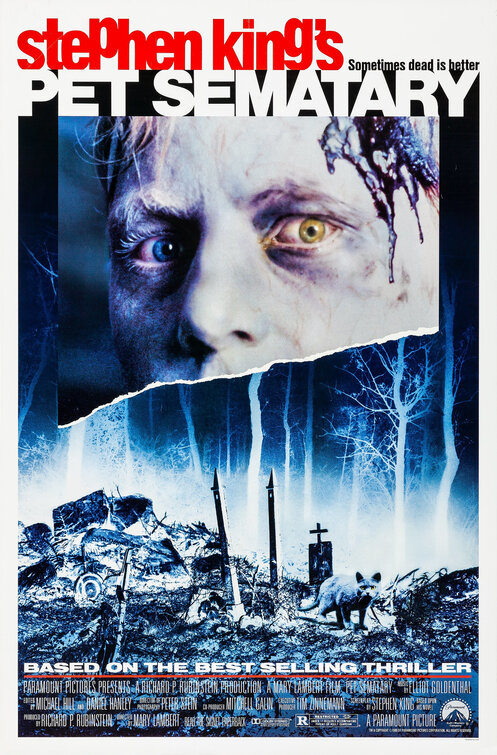
After most authors sell their books’ movie rights, they have no rights at all when they’re adapted to the screen. That wasn’t, however, the case with Stephen King’s 1983 novel PET SEMATARY.
The best-selling horror novelist’s contract specified that he’d write the PET screenplay, which would be followed faithfully in production — close to his home in Bangor, Maine.
After King finished writing his PET novel, he decided to just put it away. When his wife, actress Tabitha King, read it, she pushed him to have it published, which was definitely good advice.
King’s idea for PET came after his daughter’s cat Smuckey was killed by a speeding truck on a road near their home. King later memorialized Smuckey on gravestones in both the town’s and the movie’s pet cemeteries.
PET’s movie rights were originally bought by George Romero in 1984 for $10,000. Romero, however, wound up leaving the project to direct the sci-fi horror film MONKEY SHINES for Orion Pictures. Lindsay Doran, then a production executive at indie Embassy Pictures, loved the PET screenplay, but couldn’t get it made at Embassy. When she joined Paramount in 1985 as VP, Production, Doran tried to do it there, but the studio felt audiences had tired of King movies since so many of his books had been turned into early ’80s films.
Doran and King got lucky during the 1988 Writers Guild strike because with the flow of new scripts suddenly halted, Paramount needed to find more projects it could release in ’89. With King’s PET script already in shape to go before the cameras, Doran got a green light from Paramount to acquire the rights and start filming.
King’s contract also gave him director approval. Paramount’s first choice was Mary Lambert, who’d only made one feature — the 1987 romantic mystery SIESTA with Ellen Barkin. But Lambert was well known for directing music videos for Madonna, including MATERIAL GIRL & LIKE A PRAYER. King met with and approved Lambert, who made it clear she’d follow his screenplay very closely. Since King was on set during production, he was able to keep a very close eye on what Lambert was shooting.
When Lambert screened her first cut for Paramount, she was told it ran too long so she cut scenes to fix the problem. Worse yet, the studio didn’t like her ending, which it felt was too tame and ambiguous (no spoilers here). Lambert called it a “more spooky, sad, tragic” ending. But Paramount, of course, had the last word. The ending was reshot as a bolder and more gruesome conclusion to a horror thriller.
In the end, “gruesome” was exactly what moviegoers wanted to see. PET, which Paramount produced for $11.5M, opened April 21, 1989 and did a lively $57.5M in domestic theatres.
 ZAMM.COM
Leave a comment