
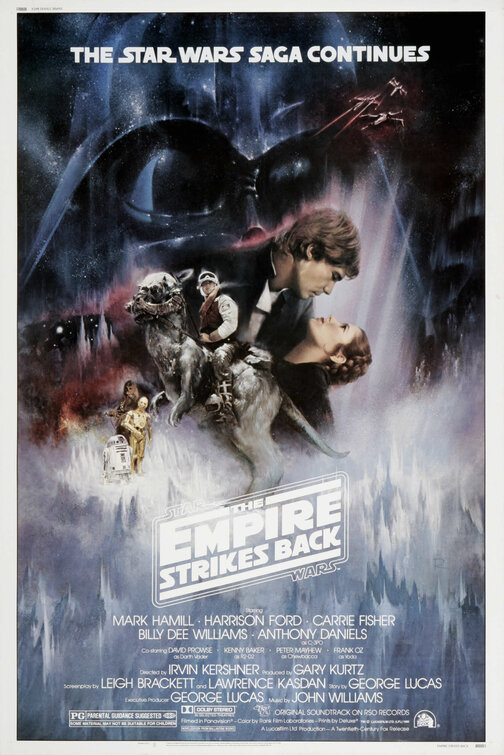
When George Lucas’s special edition of STAR WARS: THE EMPIRE STRIKES BACK opened Feb. 21, 1997, it was 17 years since the film’s original blockbuster success.
What later became Lucas’s extended franchise’s fifth episode started out as his first STAR WARS sequel in 1980. After the original’s unexpected 1977 success, Lucas wanted to get a sequel written quickly and hired screenwriter Leigh Brackett, whose credits included THE LONG GOODBYE. Brackett wasn’t well then, but she was able to finish a first draft of EMPIRE before her death in 1978.
Lucas’s next step was to outline his STAR WARS series’ story structure and write his own EMPIRE screenplay. He then brought in Lawrence Kasdan to rewrite that draft. Kasdan had been working for Lucas & Steven Spielberg on the script for RAIDERS OF THE LOST ARK. Spielberg got Kasdan a 20 minute meeting with Lucas, who quickly hired him for EMPIRE.
Directing STAR WARS had been very stressful for Lucas, who now wanted to focus on building his special effects company, Industrial Light & Magic. His choice to direct EMPIRE was Irvin Kershner, who’d been one of his film school teachers at USC and was a filmmaker he trusted. At first, Kershner passed because he thought it would be tough to top Lucas’s original success. Kershner changed his mind when his agent insisted that directing the sequel to one of the biggest boxoffice hits ever was an opportunity not to be missed.
Kershner humanized EMPIRE’s characters to a greater extent than Lucas did in the original and he created a character driven story not one that was all about sci-fi hardware. Kershner directed EMPIRE from a screenplay credited to Leigh Brackett and Lawrence Kasdan, based on a story by George Lucas. The film’s title came from producer Gary Kurtz, who’d also produced STAR WARS. Kurtz didn’t like the working title STAR WARS II because using “II” at the time suggested lower quality than an original.
To keep creative control, Lucas wanted to self-finance EMPIRE’s production. With a budget originally estimated at $18M, Lucas could handle it by using his $12M in STAR WARS profits plus a bank loan for the balance. But as production dragged on, EMPIRE’s budget escalated to $30.5M. Lucasfilm got Bank of Boston to refi a bank loan to about $31M — with $27.7M from Bank of Boston and a $3M guarantee from 20th Century-Fox (now owned by Disney) in return for a larger theatrical distribution fee plus 10% of Lucas’s merchandising profits.
It was a deal with a happy ending for all. After EMPIRE had been in theatres for about three months, Lucasfilm was able to repay its loans. EMPIRE became 1980’s top grossing domestic release with $209.4M. With reissues over the years, it’s done $550M worldwide.

 ZAMM.COM
Leave a comment